BLONEX Review: AI-Assisted Trading Features on the New CEX
Review summary
BLONEX launched in October 2026 as a centralized crypto exchange with AI tools that support user-defined strategies through alerts and risk controls rather than automated execution.
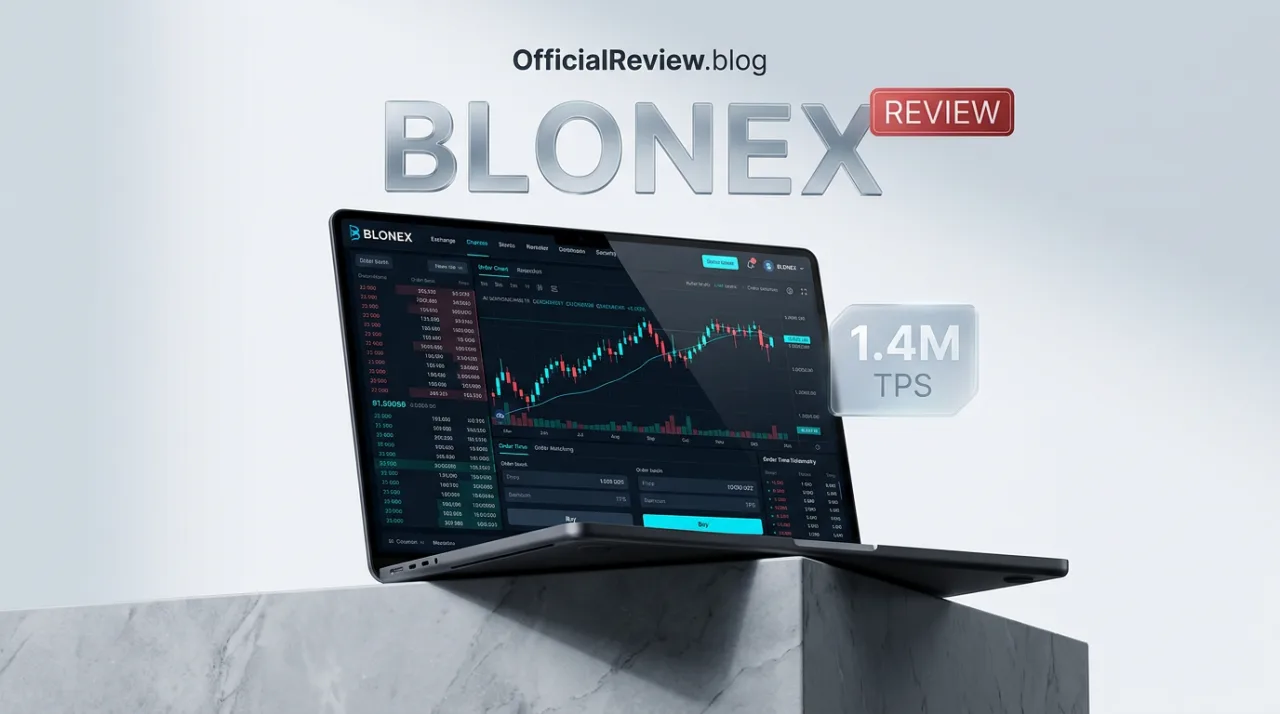
BLONEX operates as a centralized cryptocurrency exchange that launched services on October 1, 2026, and centers its offering on AI-assisted trading tools layered over spot, perpetual futures, and derivatives markets. The platform claims support for users in more than 150 countries and reports roughly 4.2 million active traders, though these figures remain unverified by independent sources. Its core approach keeps full trading control with the user while the AI component functions strictly as a monitoring and guidance system.
Platform Overview and AI Trading Features
BLONEX provides sub-millisecond order matching with an engine rated for up to 1.4 million transactions per second and states 99.99 percent uptime. The exchange lists more than 200 trading pairs. A native utility token called BLON runs on the BEP-20 standard of the BNB Chain with a total supply of one billion tokens; 25 percent of that supply was allocated to presale stages that moved from $0.05 to above $0.25, with 15 percent released at token generation event and the remainder vesting linearly over twelve months. Staking for daily rewards is already available.
The AI layer supports two modes: Beginner for guided prompts and Professional for advanced rule sets. Users create their own scenarios such as breakout or mean-reversion strategies, after which the system detects deviations, issues alerts, enforces optional leverage caps or stop-loss suggestions, and generates behavioral reports plus real-time volatility signals. The AI does not execute trades or hold funds. Registration requires standard KYC elements, and the interface supports both mobile and desktop access with mandatory two-factor authentication via authenticator apps or passkeys.
Security Measures, Pricing, and Comparisons
BLONEX states that the majority of assets sit in segregated cold storage, applies anti-phishing codes and domain pinning, and maintains a real-time risk monitoring engine. Withdrawals can be restricted through whitelisting, time-locks, and behavioral checks. Proof-of-reserves statements appear on the site, yet no public reports of completed independent security audits or regulatory licenses have surfaced as of late October 2026. The BLON token offers fee discounts, staking rewards, governance voting, and tiered access to advanced AI features.
Public user feedback remains sparse because the exchange is only weeks old. Project-affiliated channels highlight the customizable AI alerts and staking yields, while some early comments note delays in support response times and questions about actual trading volume depth. No major confirmed security incidents specific to BLONEX appear in public records, though new platforms carry standard operational risks.
| Exchange | AI Tools | Spot Pairs | Token Utility | Audit Status |
|---|---|---|---|---|
| BLONEX | Rule-based alerts and risk guidance | 200+ | Fee discounts, staking, governance | No independent audits published |
| Binance | Basic bots and signals | 600+ | BNB for discounts | Multiple public audits |
| Bybit | Copy trading and grid bots | 400+ | No native token | Regular third-party audits |
Limitations include the absence of confirmed regulatory oversight, reliance on promotional press placements for visibility, and a short operating history that prevents long-term volume or reliability verification. Expansion plans mention additional languages, assets, and deeper governance tools, but these remain forthcoming.
User Experience and Current Limitations
Daily operations center on user-defined rules rather than automated execution, which suits traders who want oversight but may frustrate those seeking fully hands-off systems. Cold-storage emphasis and withdrawal safeguards provide standard protections, yet the lack of published audit reports leaves open questions about third-party validation. The BLON presale structure and staking mechanics introduce token-specific risks such as vesting cliffs and liquidity events after any future listing.
Overall, BLONEX presents a focused AI guidance layer on top of conventional CEX infrastructure, with concrete technical claims around matching speed and token economics, while operating under the constraints typical of a platform launched in early October 2026.
Frequently asked questions
What does the BLONEX AI actually do during trading?
The AI monitors user-created rules such as breakout or mean-reversion setups, sends deviation alerts, suggests risk limits, and produces reports. It does not place orders or manage funds.
Is BLONEX regulated or audited?
No independent regulatory licenses or completed public audits have been reported as of October 2026. The platform mentions proof of reserves but provides no third-party verification documents.
How does the BLON token affect trading costs?
Holders receive fee discounts, staking rewards, and access to higher AI feature tiers. Presale participants face a 15 percent release at TGE followed by linear vesting over twelve months.
What trading pairs and products does BLONEX offer?
The exchange supports more than 200 spot and perpetual futures pairs along with derivatives. Matching engine capacity is stated at up to 1.4 million transactions per second.
Comments 5