Bybit Review: VARA Licence Details, Spot and Perpetual Fees, Proof of Reserves, and Post-2025 Hack Security Measures
Review summary
Bybit holds an active VARA VASP licence for spot trading in Dubai and publishes monthly proof-of-reserves reports verified by Hacken.
Bybit operates a centralized cryptocurrency exchange that offers spot trading, perpetual futures, and options. The platform is run by Bybit Fintech FZE and maintains its international headquarters in Dubai since 2022. Recent regulatory and security updates provide concrete details for users evaluating the service.
Bybit Licensing, Proof of Reserves, and Post-2025 Security Changes
Bybit received an active VARA VASP licence (ref. VL/26/10/003) on 20 June 2026 for exchange services limited to spot trading. The licence covers retail, qualified, and institutional clients in Dubai but excludes derivatives. This approval followed a three-year process that began with provisional status in 2024 and adds to other 2026 licences obtained in the EU and Indonesia.
Monthly proof-of-reserves reports have been published since December 2022. The 40th snapshot from September 2026 covered 50 tokens valued at $19.6 billion, with all assets at or above 100 percent backing. Independent verification uses Merkle trees through Hacken, and reports are available on Bybit’s site with an open GitHub repository.
The February 2025 breach resulted in approximately $1.4–1.5 billion lost through a compromised Safe{Wallet} interface. Bybit restored reserves within 48–72 hours using corporate liquidity and continued processing withdrawals. Subsequent measures include nine or more audits, over 50 new controls, a zero-trust architecture, enhanced MPC and HSM cold-wallet procedures, ISO 27001 certification, and AI-based monitoring that the company states blocked roughly $700 million in suspicious activity.
Bybit Fees, Core Features, and Competitor Comparison
Spot trading fees for base-tier users stand at 0.1 percent maker and 0.1 percent taker on crypto pairs. The MNT token provides a discount that can lower rates to approximately 0.075 percent. Perpetual contract fees are 0.02 percent maker and 0.055 percent taker on notional value for standard USDT and USDC pairs, with similar rates on inverse contracts. No liquidation fee applies to perps or futures. Volume-based VIP tiers reduce these rates further, and fiat pairs may carry different structures.
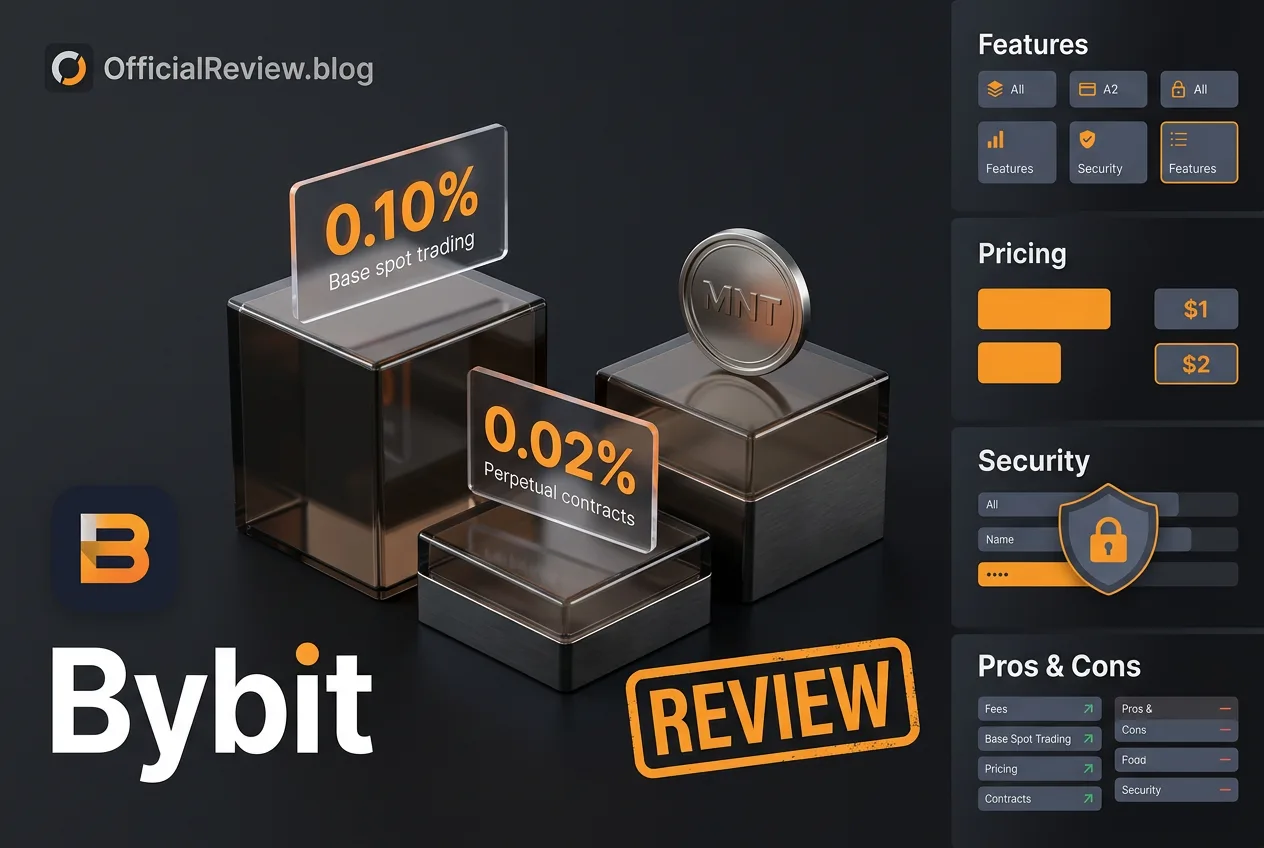
The exchange supports spot, perpetual futures, and options markets along with staking and copy-trading tools. Users access these functions through web and mobile interfaces that require standard two-factor authentication during registration. Monthly reserve attestations and post-incident security upgrades form additional operational features.
| Exchange | Spot Maker/Taker (base) | Perp Maker/Taker (base) | PoR Frequency | VARA Licence Status |
|---|---|---|---|---|
| Bybit | 0.1%/0.1% | 0.02%/0.055% | Monthly | Active (spot only) |
| Binance | 0.1%/0.1% | 0.02%/0.05% | Monthly | Not applicable |
| OKX | 0.08%/0.1% | 0.02%/0.05% | Monthly | Not applicable |
Bybit Pros and Cons, User Reports, and Practical Limitations
Public user feedback appears on forums and review aggregators. Positive comments frequently mention competitive perpetual fees, consistent monthly reserve reports, and rapid withdrawal processing after the 2025 incident. Common complaints include tiered fee structures that require substantial volume to reach lower rates and the continued absence of a derivatives licence under VARA.
Limitations include the spot-only scope of the current VARA licence and the fact that exact reserve ratios fluctuate with each snapshot. No major unresolved platform outages have been reported since the security overhaul, yet users should verify current fee schedules and licence scope directly on official documentation before large transactions.
Frequently asked questions
What does the VARA licence allow Bybit to offer in Dubai?
The active licence covers spot trading services for retail, qualified, and institutional clients. Derivatives remain outside the current approval and require separate permission.
How often does Bybit publish proof-of-reserves reports?
Reports appear monthly and have done so since December 2022. Each snapshot lists backing ratios for approximately 50 tokens and undergoes independent Merkle-tree verification.
What were the spot trading fees for base users in 2026?
Base-tier spot fees stood at 0.1 percent maker and 0.1 percent taker on crypto pairs, with an MNT token discount option that could reduce the rate to around 0.075 percent.
Did Bybit restore reserves quickly after the 2025 incident?
Corporate reserves and bridge liquidity allowed full restoration within 48 to 72 hours while withdrawals continued without interruption.
Comments
No comments yet. Be the first!