CoreWeave Forge Review: Unified Platform for AI Model Iteration Launched in 2026
Review summary
CoreWeave Forge connects the full AI improvement loop in one environment through integrations with Weights & Biases, OpenPipe, and marimo notebooks.
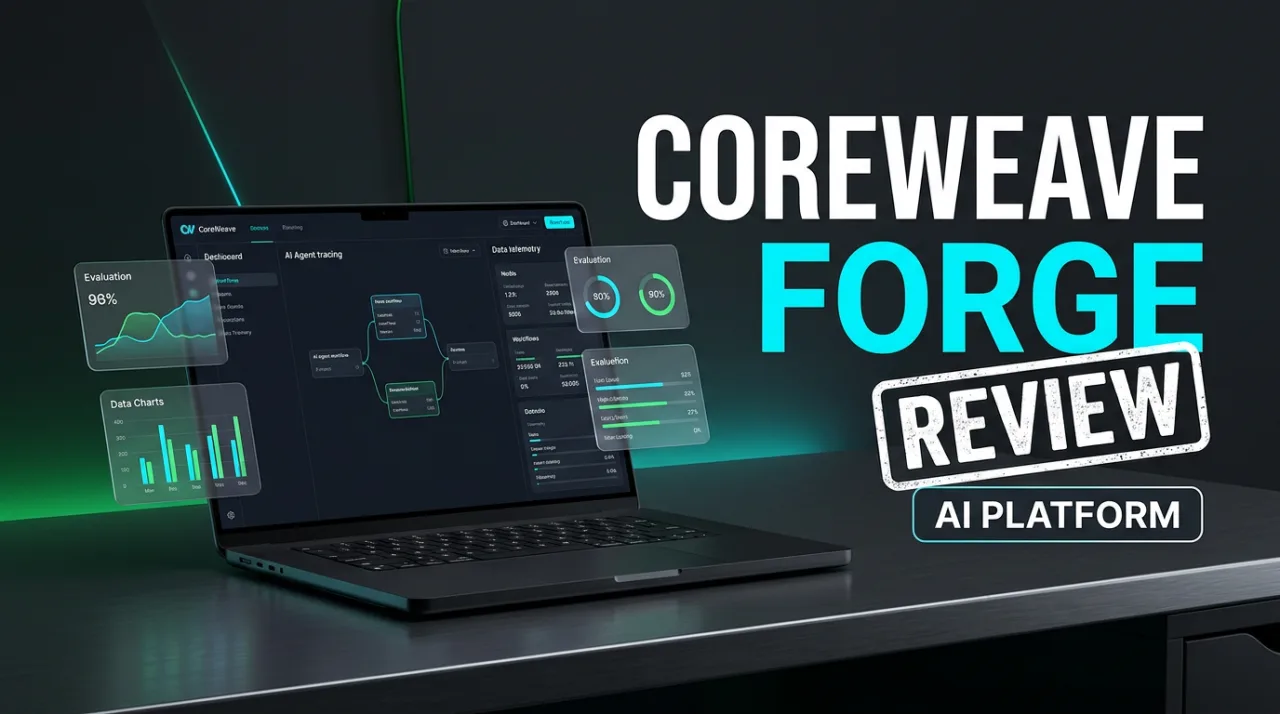
CoreWeave Forge launched on September 30, 2026, as a unified platform that ties together model runs, observation, curation, evaluation, and iteration. It incorporates existing Weights & Biases capabilities and adds agent-focused tools, while remaining open to models, frameworks, and external clouds. Early users include MasterClass, Canva, and Cognition AI.
CoreWeave Forge Features and Integration Details
The platform centers on closing the loop between production data and model updates. Agent Lens provides end-to-end tracing of agent steps, decisions, and tool calls, with monitors and options for human oversight. ARIA functions as a coding and research agent that reviews runs, suggests experiments, and proposes code changes committed to GitHub.
Sandboxes offer isolated CPU and GPU environments for reinforcement learning and evaluations, available in serverless form billed by the millisecond. The Registry stores versioned checkpoints and agent configurations in open formats. Additional components include marimo notebooks, serverless supervised fine-tuning and reinforcement learning, model distillation, and both serverless and dedicated inference endpoints for open-weight models.
Integration with Weights & Biases supplies experiment tracking, evaluations, and lineage tracking. Company benchmarks indicate Agent Lens identifies 20 percent more critical failures at roughly one-tenth the cost of general-purpose frontier models, while serverless RL runs 1.4 times faster at 40 percent lower cost than self-managed setups. RL Rollouts demonstrated roughly 15 times faster checkpoint reloads in tests with NVIDIA and You.com.
CoreWeave Forge Pricing, Security, and Practical Use
A free tier supports personal use with basic tracing, evaluations, experiment tracking, and registry access, subject to limits on model seats, storage, and ingestion. The Pro tier begins at $60 per month with a 30-day trial and adds team features, access controls, service accounts, CI/CD, and priority support for organizations under 50 employees. Enterprise plans use custom pricing and include HIPAA support, SSO, SCIM, audit logs, customer-managed encryption keys, and private connectivity.

Usage charges apply separately for inference at per-million-token rates, Sandboxes at hourly core and memory rates, and ARIA at an agent-token rate plus underlying model costs. Inference examples include Llama 3.1 8B at approximately $0.22 per million input or output tokens. Billing for Forge operates independently from CoreWeave infrastructure usage.
Security details remain limited in public documentation beyond Enterprise options such as CMEK and audit logs. The platform requires no specific technical prerequisites beyond standard browser access for its web interface, though advanced preview features like certain RL Rollouts and GPU Sandboxes currently operate under restricted availability.
| Plan | Monthly Cost | Key Limits | Best For |
|---|---|---|---|
| Free | $0 | Limited seats, storage, ingestion | Individual experimentation |
| Pro | $60+ | Teams under 50 employees | Small collaborative teams |
| Enterprise | Custom | Compliance add-ons included | Larger organizations |
Limitations, Comparisons, and Current Standing
Because the service launched only weeks ago, independent long-term user reviews remain scarce. Available feedback highlights reduced tool switching and faster iteration cycles, while common complaints center on preview status of advanced features and potential accumulation of usage-based charges. No widespread security incidents have been reported to date.
Compared with standalone Weights & Biases, Forge adds native agent tooling and serverless post-training but introduces a new interface layer. Against Hugging Face Spaces or dedicated RL platforms, it offers tighter integration of observability and inference, though at the cost of less mature third-party ecosystem support. Direct alternatives such as LangSmith focus more narrowly on tracing without the full post-training and sandbox suite.
Current constraints include the employee cap on the Pro tier that may force growing teams into Enterprise pricing, the preview status of GPU Sandboxes and Model Distillation, and the absence of extensive public case studies. The platform remains usable outside CoreWeave infrastructure, yet performance optimizations appear tuned toward that environment.
CoreWeave Forge supplies a connected environment for continuous model improvement with concrete tooling for agents and post-training. Its value depends on whether teams require the specific combination of observability, sandboxes, and serverless post-training features or can achieve similar results with existing separate services at lower total cost.
Frequently asked questions
What is CoreWeave Forge designed to do?
It unifies the cycle of running, observing, curating, evaluating, and improving AI models and agents within a single environment that incorporates Weights & Biases tracking and new agent-specific services.
How much does the Pro tier of CoreWeave Forge cost?
The Pro plan starts at $60 per month after a 30-day free trial and targets teams with fewer than 50 employees, with usage charges for inference, sandboxes, and ARIA billed separately.
Are there independent reviews of CoreWeave Forge yet?
Public independent reviews remain limited because the platform launched on September 30, 2026. Early coverage focuses on feature announcements rather than extended user testing.
Does CoreWeave Forge require use of CoreWeave infrastructure?
The service supports models and workflows across multiple clouds and frameworks, though several performance optimizations and certain preview features are tuned for CoreWeave hardware.
Comments 6