doubleAI Maxwell Review: Code Execution Models for Hardware Optimization
Review summary
doubleAI Maxwell launched as the first Code Execution Model that rewrites running binaries for hardware fit while proving correctness. Early benchmarks show major speedups on data and AI workloads.

doubleAI Maxwell review examines the runtime system released on October 19, 2026, that rewrites machine-code binaries while programs execute. The tool targets CPU and GPU workloads and applies changes only after formal verification confirms behavior remains identical to the original.
doubleAI, founded in Tel Aviv in 2023, developed Maxwell with backing from Nvidia, Dell, Lightspeed, and Bessemer. The service operates at the binary level without altering source code, distinguishing it from source-level optimizers.
doubleAI Maxwell Overview and Core Technology
Maxwell functions as a Code Execution Model that monitors executing programs on CPUs and GPUs. It identifies inefficient data movement and hardware interactions, then generates replacement machine code. Each replacement undergoes mathematical proof of equivalence before deployment, with guardrails that revert changes if needed.
The system differs from traditional JIT compilers by working after compilation on already running binaries. It analyzes real-time hardware metrics and data patterns rather than static code. doubleAI reports that source code stays untouched, allowing teams to keep existing build pipelines intact.
Early access runs through heymaxwell.ai. The company states it plans usage-based pricing tied to measured compute savings, though exact rates and billing tiers remain undisclosed at launch. Integration requires no code changes beyond installing the runtime agent.
Performance Benchmarks and Early Results
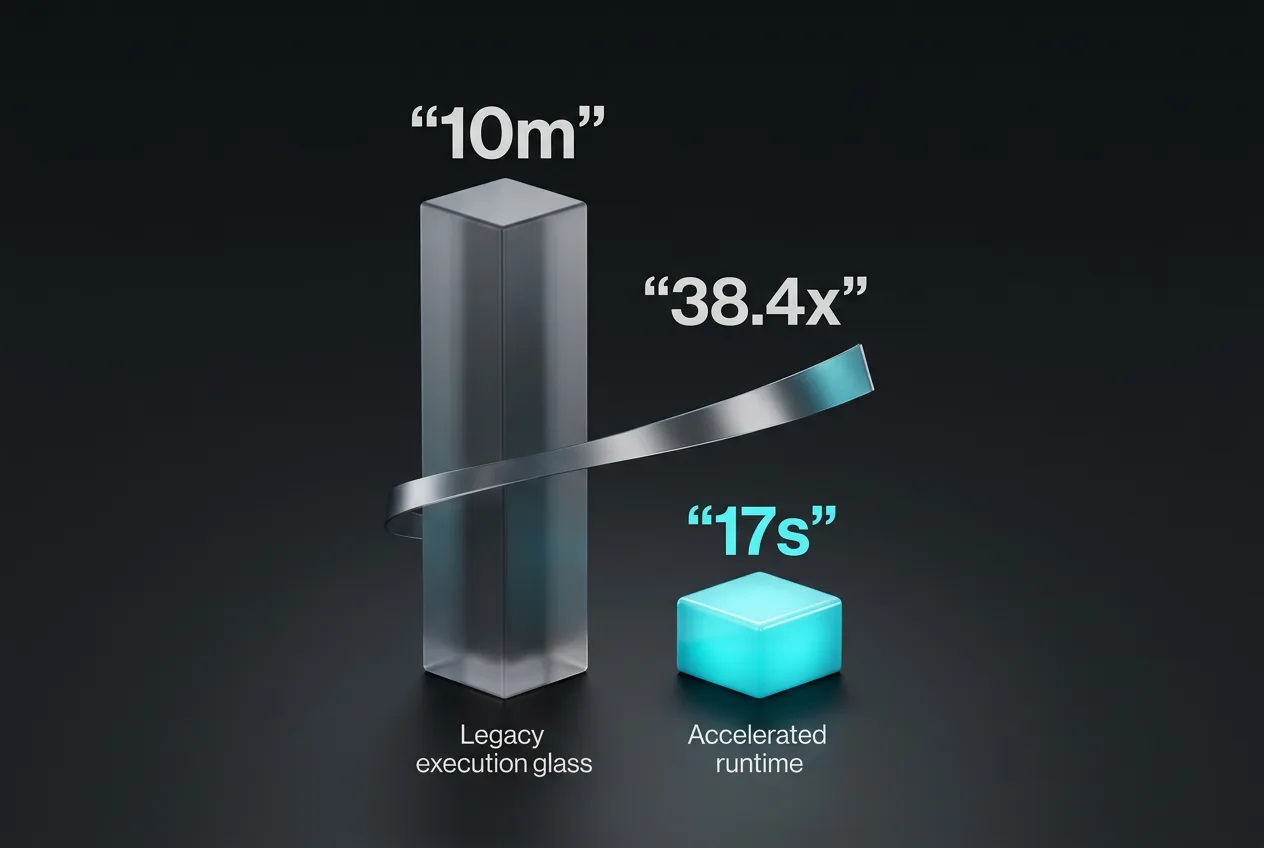
doubleAI Maxwell delivered a 38.4× speedup on the pandas PDS-H benchmark, reducing runtime from 10 minutes to roughly 17 seconds. AI inference kernels showed gains above 4.5× on expert-tuned baselines. One early customer reported a 67 percent reduction in compute costs.
On the LTX-2.5 4K video generation task running on two NVIDIA B200 GPUs, execution time dropped from 250 seconds to 134 seconds. Optimizations included reduced GPU-to-GPU transfers from 262 MB to about 1 MB per block, plus kernel selection and tiling changes. Output quality stayed identical, with bit-for-bit audio and 41 dB PSNR for video.
Earlier internal tests on cuGraph algorithms produced a 3.6× mean speedup across all routines on A100, L4, and A10G hardware. In Blackwell kernel searches completed in June 2026, Maxwell outperformed PyTorch baselines on 90 to 99 percent of 235 kernels, with a geometric mean improvement of 3.14×. All results remain company-reported pending wider third-party validation.
| Workload | Baseline Time | Maxwell Time | Speedup |
|---|---|---|---|
| pandas PDS-H | 10 min | 17 s | 38.4× |
| LTX-2.5 4K video | 250 s | 134 s | 1.87× |
| Blackwell kernels (geomean) | PyTorch | Optimized | 3.14× |
Adoption Considerations and Comparisons
doubleAI Maxwell faces limited public user reviews because the service launched only one day before this writing. No widespread complaints or independent audits of correctness proofs have appeared yet. Company materials and contemporaneous reporting from The Next Web and The Register form the current evidence base.
Compared with standard PyTorch kernels, Maxwell showed higher hit rates on Blackwell hardware. Against hand-tuned cuGraph, it produced consistent speedups while releasing results as a drop-in library called doubleGraph. Unlike source-code agents, it leaves original source unchanged, which reduces integration risk for production teams.
Limitations include the absence of published independent benchmarks and reliance on company-controlled test cases. Domain expansion beyond data pipelines and AI inference kernels is still in development. Formal verification overhead and fallback mechanisms may add measurable latency in some workloads, though doubleAI has not quantified this cost.
doubleAI continues open-sourcing selected optimizations, including the LTX changes. Enterprise interest centers on reducing hardware requirements for large AI and data jobs, with further Code Execution Model releases expected in additional domains.
Frequently asked questions
What is a Code Execution Model?
A Code Execution Model runs inside executing programs, rewrites binaries at the machine-code level, and verifies that each rewrite preserves original behavior through formal methods.
How fast is doubleAI Maxwell on real workloads?
Company tests report 38.4× on pandas PDS-H and 1.87× on LTX-2.5 4K video generation. These figures come from workloads already tuned by experts.
Does doubleAI Maxwell change source code?
No. All modifications occur at the binary level during runtime, leaving source files and build processes untouched.
When will doubleAI Maxwell pricing details appear?
doubleAI plans usage-based pricing based on achieved savings. Specific rates and tiers have not been released as of October 20, 2026.
Comments 5