EnCirca review: Doma Protocol Integration for Domain Tokenization
Review summary
EnCirca became the first ICANN registrar to integrate Doma Protocol for domain tokenization in 2025, turning standard DNS names into ERC-721 tokens while keeping full registry functions intact.
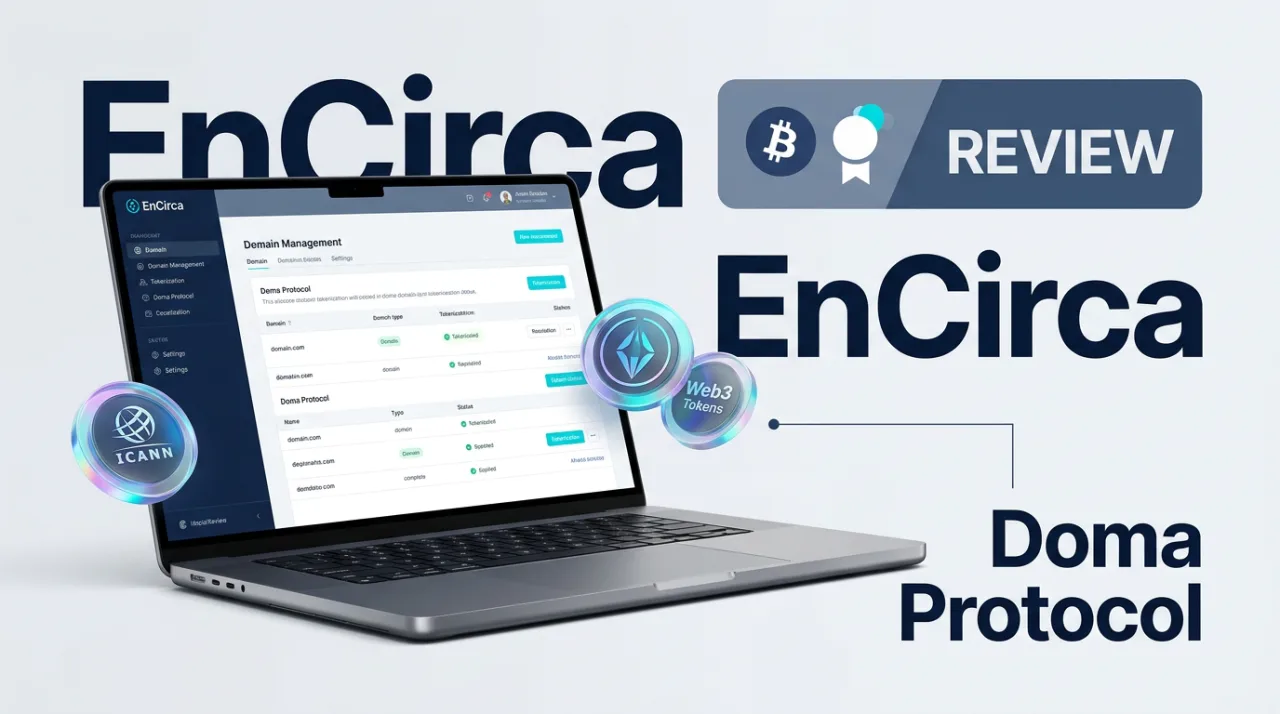
EnCirca review examines the Boston-based ICANN registrar’s 2025 launch of domain tokenization through Doma Protocol. The service converts existing gTLD domains into on-chain Domain Ownership Tokens without altering DNS resolution or ICANN lifecycle rules. Users can manage tokenized assets through hosted wallets or external connections while retaining standard renewal and transfer processes.
EnCirca review: Doma Protocol Integration and Registrar Background
EnCirca received ICANN accreditation in 2001 under IANA number 455 and focuses on policy-sensitive extensions such as .BANK, .PHARMACY, and .CPA. It oversees roughly 19,000 gTLDs and provides white-label services for resellers. The company maintains standard DNS management, hosting options, and security features alongside the newer tokenization offering.
Integration with Doma Protocol began with public wallet features in May 2025, followed by full tokenization on November 26, 2025. Domains become ERC-721 NFTs on the Doma Chain, an L2 solution that records ownership on-chain while the original registrar remains the authoritative source for DNS records. The process supports gasless transactions through EnCirca-hosted wallets that require no seed phrases or separate crypto installations for basic operations.
Tokenization covers approximately 97 percent of the world’s 380 million domains, including most gTLDs and new TLDs, though certain ccTLDs and eligibility-restricted extensions remain excluded. Existing domains registered or transferred to EnCirca can be tokenized without creating new namespaces. DNSSEC and full ICANN compliance, including UDRP handling, stay active after tokenization.
Web3 Identity Features, Pricing Details, and Platform Limits
Tokenized domains link to MyPublicWallet profiles hosted on IPFS, displaying contact data, NFTs, and POAPs. The system supports wallet-based authentication and works with more than 400 wallets across Bitcoin, Ethereum, and Solana networks. Human-readable names can serve as identifiers for DeFi applications and decentralized services, providing a portable cryptographic identity layer.
No separate tokenization fees appear in public announcements, though standard EnCirca registration and renewal charges continue to apply. Doma ecosystem data through mid-October 2026 shows roughly 261,500 tokenized assets, 45.3 million transactions, and 62,300 wallets, with total trading volume near 577 million dollars. EnCirca participates as one of the first registrars alongside partners such as InterNetX.
Practical steps require moving the domain to EnCirca if necessary, connecting a wallet or using the hosted option, selecting a chain, and signing the transaction. The resulting NFT remains tradable, leasable, or usable as collateral while DNS functionality continues uninterrupted. Users manage assets through the Doma dashboard after tokenization completes.
| Feature | EnCirca + Doma | Traditional ICANN Registrar | ENS Integration |
|---|---|---|---|
| Token Standard | ERC-721 on Doma Chain | None | ERC-721 on Ethereum |
| DNS Resolution | Preserved | Standard | Requires DNSSEC or gateway |
| ICANN Compliance | Maintained | Maintained | Not applicable |
| Identity Profiles | IPFS-hosted via MyPublicWallet | None | Limited text records |
Security Considerations, User Feedback, and Remaining Constraints
Security relies on registrar signature verification and Doma’s compliance modules that enforce ICANN transfer and data rules. No major security incidents have been reported for the EnCirca implementation since launch. Public user reviews remain limited because the service reached broad availability only in late 2025; early mentions on domain forums focus on successful tokenization of standard gTLDs without loss of resolution.
Common constraints include the inability to tokenize certain country-code extensions and the requirement that domains reside under EnCirca management before conversion. The platform has not yet released detailed fee schedules for advanced features such as fractional ownership or subdomain staking. Broader adoption depends on additional registrar participation and continued development of Doma’s trading and bridging tools.
Frequently asked questions
How does EnCirca domain tokenization work with Doma Protocol?
Users transfer or register a supported domain with EnCirca, connect a wallet or use the hosted option, and sign a transaction that creates an ERC-721 token on the Doma Chain while DNS records remain unchanged.
Which domains can be tokenized through EnCirca?
The service covers nearly all major gTLDs and new TLDs, representing about 97 percent of global domains, but excludes many ccTLDs and extensions with eligibility restrictions.
Does tokenization affect standard domain renewal and transfers?
No. ICANN lifecycle policies, renewal fees, and dispute processes stay in effect because the original registrar continues to serve as the authoritative source for DNS records.
What identity features does the MyPublicWallet integration provide?
Tokenized domains link to IPFS-hosted public profiles that display contact information, NFTs, and POAPs, with support for wallet-based authentication across hundreds of external wallets.
Comments 3