GoDaddy Developer Platform review: APIs for Hosting, Email, Commerce and AI Agent Integration
Review summary
The GoDaddy Developer Platform supplies REST APIs and CLI access for domains, hosting, email and commerce, with features built for developers and AI agents.
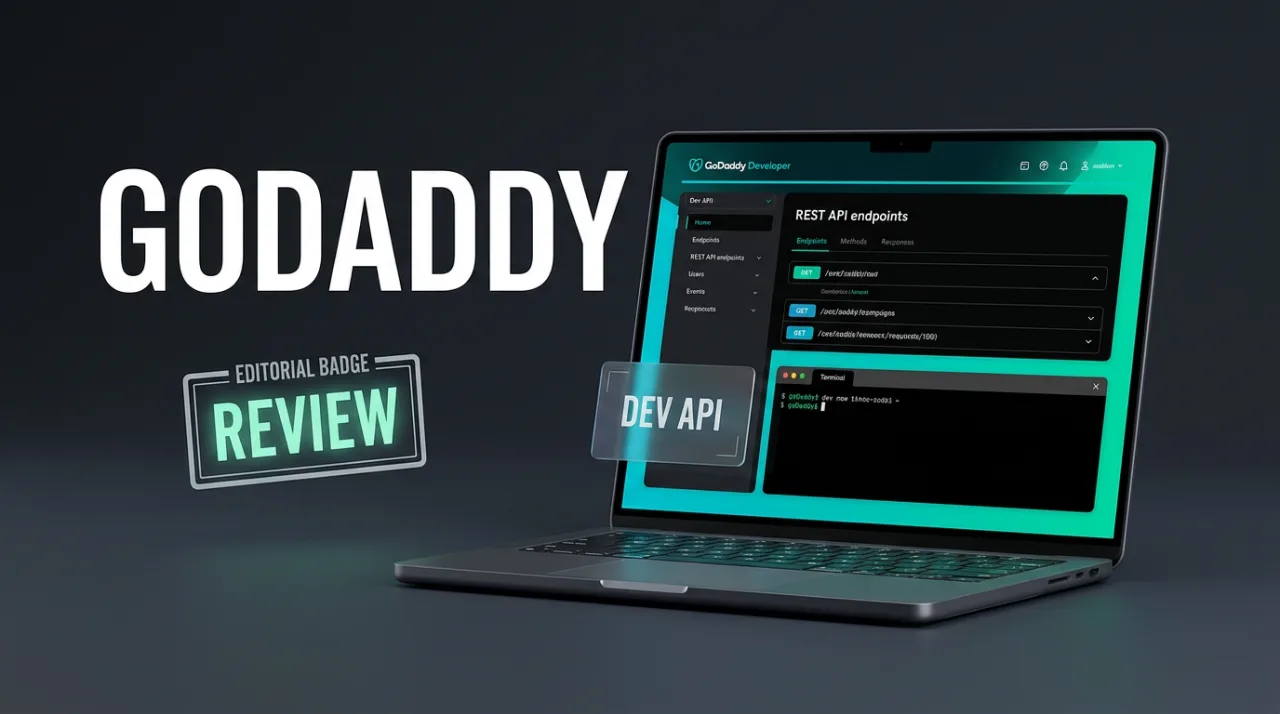
GoDaddy Developer Platform review shows a unified set of REST APIs launched in stages during 2026 that give programmatic control over domains, hosting, email and commerce products. The platform uses a single base URL, Personal Access Tokens and OpenAPI specifications to support both human developers and automated AI agents. Launched with domain endpoints in July 2026 and expanded in October 2026 to include hosting, email and commerce, the service targets full business setup workflows without dashboard interaction.
Overview and Core Capabilities
The GoDaddy Developer Platform provides JSON-based REST endpoints and a command-line tool called gddy. Any holder of a GoDaddy account can generate Personal Access Tokens with granular scopes such as domains.domain:create or hosting.application:*. Documentation includes machine-readable rate-limit headers and idempotency-key support for write operations. An OTE sandbox environment allows testing without live purchases.
Domains API endpoints cover availability checks, suggestions, quote-then-execute registration and DNS record management. The Email API follows a three-call sequence: eligibility check, mailbox creation and status polling, automatically configuring MX, SPF, DKIM and DMARC records. Hosting endpoints currently support Node.js applications with Git or zip uploads, secret management and log retrieval, while Commerce endpoints manage stores, catalog items via GraphQL and order processing. All operations return consistent error formats suitable for LLM parsing.
Async operations require polling for completion status. No native webhooks or first-party SDKs are published at this time. The platform documentation includes example prompts for common agent-driven flows such as domain registration followed by email provisioning.
Access, Security, Limitations and Comparisons
Authentication relies on scoped Personal Access Tokens or OAuth flows. Rate limits trigger standard 429 responses with retry-after headers. Purchases still require explicit human consent even when initiated by an agent token. Hosting remains limited to Node.js runtimes through late 2026, and commerce operations apply only to existing GoDaddy stores. No service-level agreement is published for API uptime.

Users report that availability checks sometimes require active paid plans despite relaxed 2024 gates on other endpoints. The platform supplies OpenAPI specs and an llms.txt file to help agents discover endpoints, yet lacks built-in identity services beyond an earlier separate Agent Name Service initiative.
Compared with Namecheap API and Cloudflare Registrar API, GoDaddy offers broader product coverage in one identity but trails in webhook support and multi-language SDK availability. Namecheap provides simpler domain-only endpoints with lower documented rate limits, while Cloudflare emphasizes DNS and security features over email or commerce provisioning. GoDaddy’s quote-then-execute model adds an extra consent step not present in the other two services.
Practical constraints include polling overhead for async tasks and the requirement to maintain separate scopes for mailbox creation versus domain purchase. Developers integrating AI agents should test consent flows in the OTE sandbox before production use. No public data yet exists on sustained throughput under heavy agent workloads.
Frequently asked questions
How do I authenticate with GoDaddy Developer Platform APIs?
Generate a Personal Access Token from the developer portal and assign granular scopes for each product area. Tokens support OAuth flows and replace older sso-key methods for most endpoints.
What rate limits apply to GoDaddy APIs?
Rate limits are returned in response headers and vary by credential and endpoint. Exceeding limits returns HTTP 429 with a retry-after value; no fixed per-minute numbers are published publicly.
Does the GoDaddy Developer Platform support AI agents directly?
Endpoints use consistent JSON and error formats, and documentation includes example prompts for agent workflows. Scoped tokens and consent requirements are intended to reduce misuse during automated registration flows.
Is the GoDaddy Email API available worldwide?
The API is offered to any GoDaddy account holder with eligible domains. Provisioning automatically sets required DNS records, but final mailbox activation depends on domain status and local eligibility checks.
Comments 1