Hydrogen-1.0 Review: Deep Principle's 753B Open-Weight Model for Chemistry Tasks
Review summary
Deep Principle released Hydrogen-1.0, a 753B-parameter open-weight MoE model trained on chemistry and life-sciences data, with reported gains on scientific benchmarks over GPT-6-Astra.
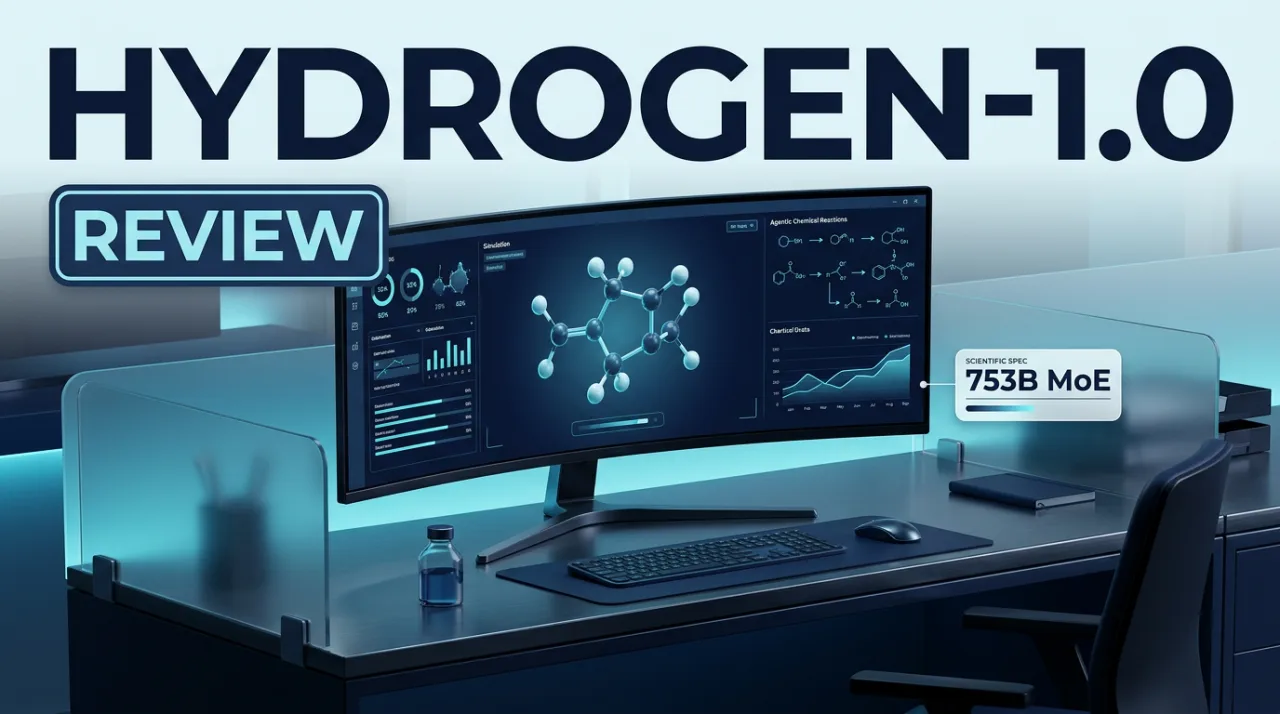
Hydrogen-1.0 review begins with its release on November 2, 2026, by Deep Principle in Hangzhou. The 753B-parameter Mixture-of-Experts model targets scientific reasoning in chemistry, materials science, and biology. It builds on GLM-5.3 base weights through domain-specific post-training that incorporates laboratory records and failed experiments.
Overview of Hydrogen-1.0 Architecture and Training
Deep Principle trained Hydrogen-1.0 using supervised fine-tuning and reinforcement learning on proprietary datasets that include agentic discovery trajectories. The glm_moe_dsa architecture supports a 1M-token context window and outputs up to 128K tokens. Weights appear in BF16 format along with NVFP4 and MXFP4 quantized versions optimized for NVIDIA Blackwell and AMD MI350X hardware. Deployment runs through SGLang on eight GPUs with tensor parallelism. The MIT license governs distribution, though access requires acceptance of gated terms on Hugging Face and ModelScope.
The company, founded in February 2024, focuses on AI-driven materials and chemistry research that combines quantum chemistry with high-throughput experiments. Co-founders Haojun Jia and Chenru Duan hold MIT doctorates. Funding includes seed through Series A rounds backed by Baidu Ventures and Lenovo Capital. The model also connects to the NeuroSpark API and the Mira AI Scientist platform for experiment planning and protocol generation.
Performance on Scientific Benchmarks and Internal Tasks
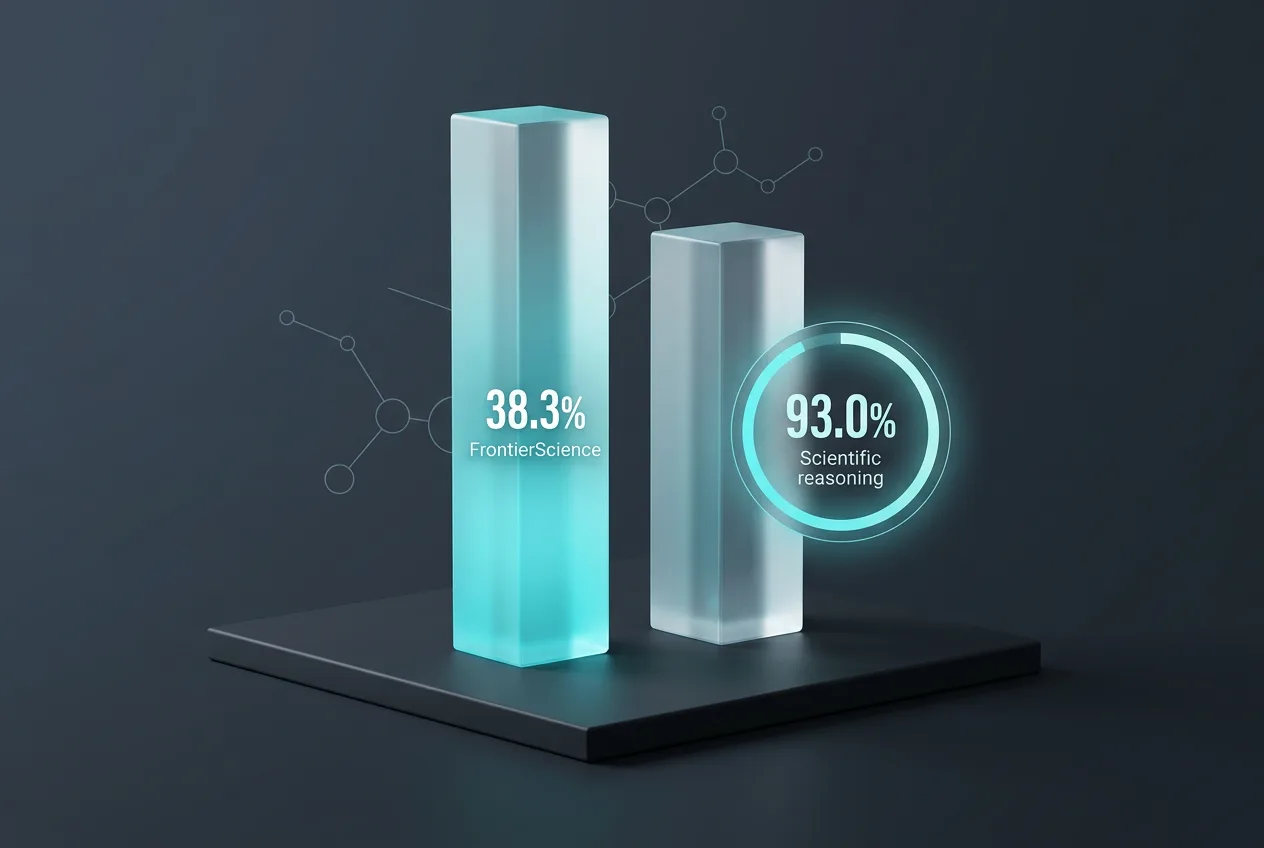
Vendor-reported results place Hydrogen-1.0 at 38.3 percent on FrontierScience-Research, ahead of GPT-6-Astra at 33.3 percent. On GPQA-Diamond it scores 93.0 percent, comparable to Kimi-K3. Internal evaluations show a 5.13-point lead over GPT-6-Astra on scientific computing and a 4.76-point lead on forward reaction prediction. It trails by 3.33 points on NMR structure elucidation. In a five-round transition-metal complex design task, the model reached a mean best HOMO-LUMO gap of 4.318 eV versus 3.689 eV for GPT-6-Astra and 3.353 eV for Kimi-K3.
Intended applications include research assistance for simulation workflows such as GROMACS polymer molecular dynamics, reaction-network exploration, and NMR analysis. Outputs carry the requirement for expert review before any experimental use. No independent third-party verification of the benchmark numbers has appeared yet in public sources.
Access Options, Limitations, and Competitor Comparison
Users obtain weights from Hugging Face or ModelScope after agreeing to terms. Quantized variants reduce hardware demands for Blackwell and MI350X systems. No public pricing details exist for API access through NeuroSpark or Mira. Full training datasets and recipes remain undisclosed. The model positions itself as a foundation for open scientific discovery tools, with community evaluations and fine-tuning expected in coming months.
Compared with closed models, Hydrogen-1.0 offers full weight access under MIT terms while GPT-6-Astra and Kimi-K3 remain proprietary. It exceeds those systems on several chemistry-specific internal tasks but shows narrower margins on general science benchmarks. Limitations include reliance on self-reported metrics, the gated download process, and the explicit instruction that outputs need human scientific oversight before practical application. No public data addresses long-term stability or fine-tuning outcomes at scale.
Frequently asked questions
What base model did Deep Principle use for Hydrogen-1.0?
Hydrogen-1.0 started from Z.ai’s open GLM-5.3 weights and received additional post-training on chemistry and life-sciences data.
Where can users download Hydrogen-1.0 weights?
Weights are available on Hugging Face and ModelScope after accepting the gated access terms under an MIT license.
How does Hydrogen-1.0 compare on GPQA-Diamond?
The model scores 93.0 percent on GPQA-Diamond according to Deep Principle, placing it roughly level with Kimi-K3.
What context length does Hydrogen-1.0 support?
The architecture provides a 1M-token context window with maximum output length of 128K tokens.
Comments
No comments yet. Be the first!