NVIDIA Nemotron Review: Open Models for Multimodal Enterprise Agents
Review summary
NVIDIA released Nemotron 3.5 Super VL and Bolt variants in October 2026 as open-weight multimodal models aimed at agentic workflows and specialized enterprise tasks.
NVIDIA released the Nemotron 3.5 family on October 15, 2026, adding two multimodal open models designed for agentic tasks that combine text, images, documents, and short video. The Super VL and Bolt variants target organizations that want customizable alternatives to closed frontier models for privacy-sensitive or domain-specific workloads.
What Nemotron 3.5 Offers for Enterprise AI Workloads
The Super VL model contains 120 billion total parameters with 12 billion active parameters in a hybrid Mamba-Transformer architecture paired with a C-RADIO vision encoder. It processes PDFs, charts, tables, webpages, and video clips up to roughly two minutes while supporting a 1 million token context window, instruction following, tool use, and multistep agent sequences. The Bolt 74B-A9B variant uses 74 billion total parameters with 9 billion active ones and ships in a 2-bit quantized form that fits on 24 GB GPUs for local research, coding, and browsing agents. A smaller Bolt E4B version for edge and voice agents is scheduled for October 23, 2026.
Weights are released under the OpenMDW-1.1 license, which permits commercial use and fine-tuning with attribution. Models are hosted on Hugging Face, NVIDIA NIM, OpenRouter, and ModelScope. Post-training and dataset recipes are available through NeMo, and enterprise customers can access NIM containers through NVIDIA AI Enterprise at approximately $4,500 per GPU per year. Hardware support spans DGX systems, RTX PRO cards, Jetson, and Blackwell, Hopper, and Ampere GPUs.
Early enterprise deployments include Scale AI for document processing, Ramp for receipt handling, and AI21 for cybersecurity classification. These cases report throughput gains between 5x and 50x and latency reductions up to 10x compared with prior internal pipelines, though results depend on task specialization and post-training.
Performance Data, Comparisons, and Practical Limits
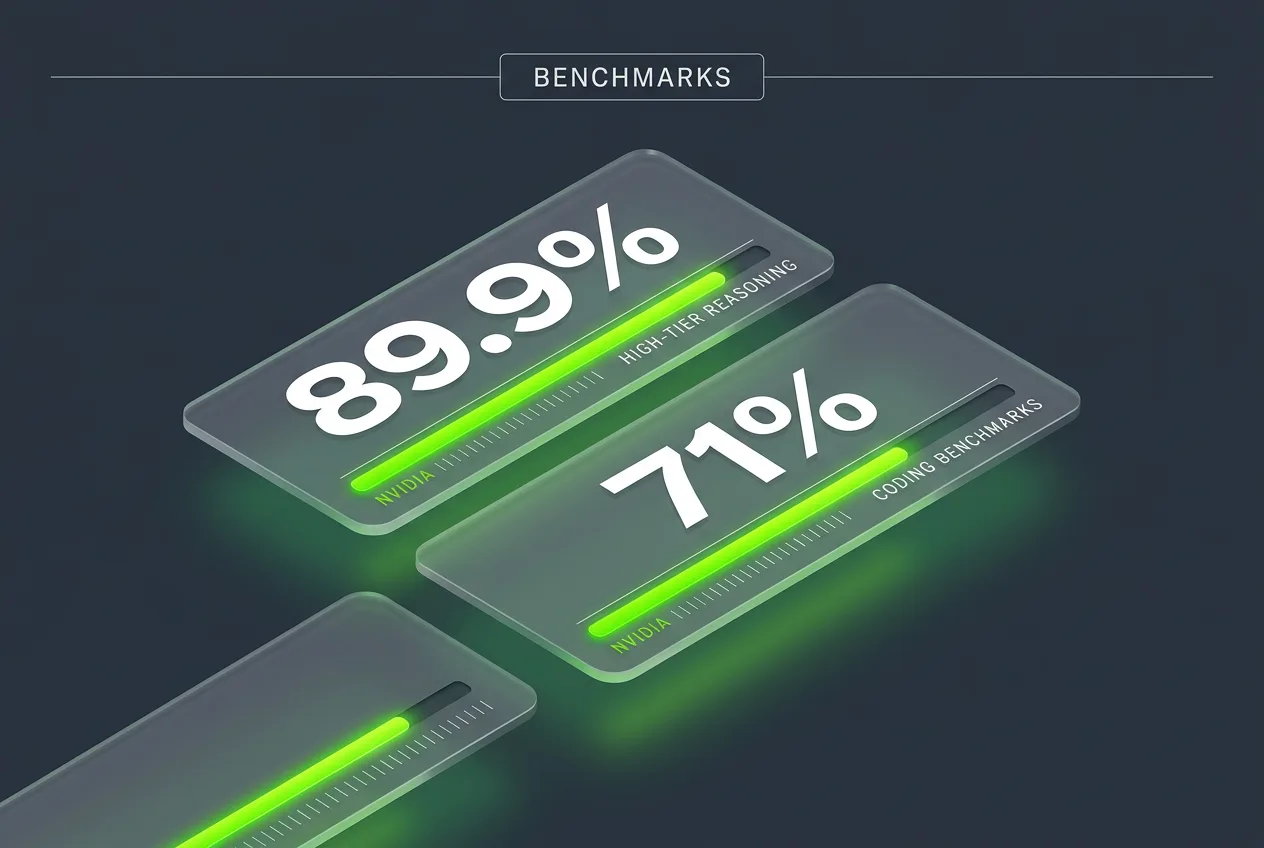
Reported scores place Super VL near the top of open-weight models on the Artificial Analysis Intelligence Index at 26 to 26.5 points. It records 89.5 to 89.9 percent on GPQA Diamond, 71 percent on SWE-bench Verified, 77.5 to 78 percent on BrowseComp, and 80 percent on CharXiv chart tasks. Throughput on single-GPU agent workloads reaches up to five times that of comparable models according to NVIDIA tests. Bolt leads its memory class on PinchBench.
Direct comparisons with closed models show Super VL trailing Claude Opus 5 and GPT-6.1 on broad general benchmarks yet exceeding them on certain fine-tuned tasks after adaptation, with gains ranging from 9 to 44 percent. License terms require attribution on derivative works, and independent verification of the highest reported numbers remains limited because most published figures originate from NVIDIA or partner evaluations.
Deployment requires NVIDIA software stacks for optimal performance, although community runtimes such as vLLM and Ollama are adding support. Organizations without existing NVIDIA infrastructure face additional setup steps. Public user reviews remain sparse because the models launched only days before this review; enterprise case studies cite accuracy lifts in medical claims and security resilience, while complaints center on the need for substantial post-training to reach peak results and the absence of long-term stability data. Limitations include the 24 GB memory requirement for the main Bolt variant, the two-minute video cap in Super VL, and reliance on NVIDIA hardware for full throughput claims. Ongoing releases and external benchmarks will determine whether these models sustain their early positioning against both open and closed competitors.
Frequently asked questions
What license covers Nemotron 3.5 weights?
The models use the OpenMDW-1.1 license, which allows commercial use and fine-tuning provided attribution is given on derivatives.
How much context does Super VL support?
Super VL handles up to 1 million tokens and processes text, images, documents, and video clips of roughly two minutes within a single forward pass.
What enterprise pricing applies to NIM deployment?
NVIDIA AI Enterprise NIM access costs about $4,500 per GPU per year; the weights themselves remain free to download under the open license.
Which hardware runs the Bolt 74B variant locally?
The quantized 74B-A9B model fits on 24 GB GPUs and targets consumer or professional RTX cards for local agent tasks.
Comments 4