OpenAI Decisions API Review: Performance, Pricing, and Use Cases for Fast Application Decisions
Review summary
The OpenAI Decisions API delivers typed probabilistic outputs through a dedicated endpoint for classification, scoring, and choice tasks, with median latencies under 320 ms and input-only billing.
The OpenAI Decisions API supplies structured answers such as predicates, choices, or scores instead of generated text. Launched for general availability on October 22, 2026, the service runs exclusively on gpt-6-luna and accepts text, images, JSON, or conversation history plus up to 400 named questions in one request.
Developers send a POST request to /v1/decisions and receive probability-weighted results that integrate directly into routing, risk, or attribution logic. The endpoint supports US and EU data residency plus zero data retention and HIPAA options for eligible accounts.
OpenAI Decisions API Features and Capabilities
The API processes shared context once and applies it across multiple questions, which reduces redundant token usage. Inputs include inline base64 images or public URLs, native JSON objects, and full conversation histories that contain tool calls. Individual questions can reference images for tasks such as damage detection or visual classification.
Additional capabilities added after the October 6 beta include prompt caching, native GPT-Live delegation for voice sessions, organization-level usage reports, and a dedicated playground at platform.openai.com/decisions. SDK support covers Python 3.26.0 and later along with JavaScript 7.30.0 and later. These features target high-volume decision loops in content routing, command risk scoring, and agent next-action selection.
Reported production results include Box achieving five times faster routing at unchanged accuracy, Datadog recording 40 times faster p95 for risk scoring, and Sierra reaching under 280 ms p95 with three times faster execution. Ramp reported four times faster attribution at 30 percent lower cost, while Speak reduced action time to 0.13 seconds. These outcomes reflect the endpoint’s design for repeated, low-latency inference rather than open-ended generation.
Decisions API Pricing, Performance, and Comparisons
Billing covers input tokens only at $0.10 per million, with cached inputs at $0.01 per million. No separate charges apply for outputs, cache reads, or cache writes, although regional or long-context premiums may still appear. Prompt caching became available after the beta period.
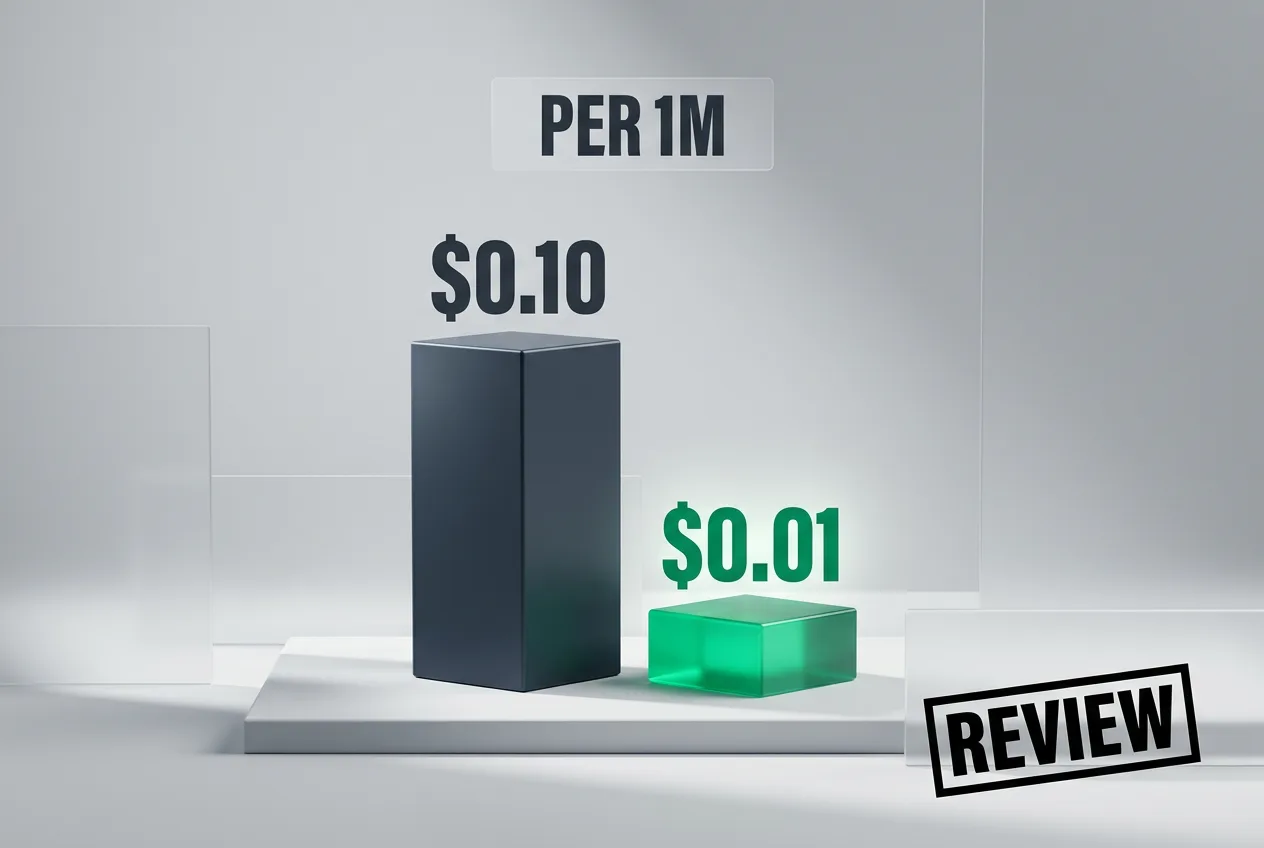
Independent benchmarks place median text latency between 180 ms and 320 ms, with p95 values frequently under 500 ms. Image inputs increase latency to roughly 230–700 ms depending on resolution. OpenAI internal tests claim roughly ten times the speed of the same model through the Responses API.
| Service | Input Price per Million | Modalities | Median Latency | Key Strength |
|---|---|---|---|---|
| OpenAI Decisions API | $0.10 | Text + images | 180–320 ms | Compliance options and ecosystem integration |
| TypeSafe Jev | $0.042 | Text only | Often lower | Lower cost for pure text workloads |
| Perplexity / Cloudflare Clef | Varies | Text | Comparable | Alternative routing engines |
The table shows that TypeSafe Jev undercuts the Decisions API on price and sometimes latency for text-only tasks, yet lacks image handling and the compliance certifications available from OpenAI. Perplexity and Cloudflare Clef provide comparable routing speeds but require separate integration work outside the OpenAI SDK surface.
User Feedback, Limitations, and Practical Considerations
Enterprise customers cited in OpenAI announcements report consistent accuracy alongside the measured speed gains. Public benchmarks from ChatFrom, Agent.Nexus, and LangWatch note occasional longer tail latencies compared with lighter text-only alternatives. No widespread complaints about correctness have surfaced in contemporaneous reporting as of October 23, 2026.
Limitations include exclusive dependence on gpt-6-luna, absence of output token charges that could mask total cost in high-volume scenarios, and image-related latency spikes that may affect real-time voice or avatar use. Organizations without HIPAA eligibility cannot access zero data retention. Prompt caching requires explicit configuration after the beta window.
The service remains an official OpenAI product with public documentation, SDK releases, and enterprise references. Its primary value appears in workloads that combine image inputs, strict compliance needs, or deep integration with existing OpenAI tooling, while pure-text classification tasks may find lower-cost options sufficient.
Frequently asked questions
What output types does the OpenAI Decisions API return?
It returns predicate probabilities between 0 and 1, choices selected from supplied options with confidence scores, or score values computed as probability-weighted averages across ordered levels.
How much does the Decisions API cost per million tokens?
Input tokens are billed at $0.10 per million, with cached inputs at $0.01 per million. There are no separate charges for outputs or cache operations on this endpoint.
Does the API support image inputs?
Yes. Images can be supplied via inline base64 or public HTTP(S) URLs and referenced within individual question instructions for classification or inspection tasks.
What are the main alternatives to the OpenAI Decisions API?
TypeSafe Jev offers lower pricing for text-only workloads, while Perplexity and Cloudflare Clef provide routing capabilities that require separate integration outside the OpenAI platform.
Is the OpenAI Decisions API available for HIPAA workloads?
Zero Data Retention and HIPAA options exist for eligible customers, along with US and EU inference residency controls.
Comments 2