Reflection Beam Review 2026: Features, Pricing, Pros & Cons
Review summary
Reflection Beam is Reflection AI’s 501B-parameter open-weight MoE model released in October 2026 for coding and reasoning tasks.
Reflection Beam (Beam 1.0) is an open-weight sparse Mixture-of-Experts language model developed by Reflection AI. It contains 501 billion total parameters with 23 to 23.4 billion active per token and supports a 1 million token context window. The model targets coding, reasoning, and agentic workflows and was released under the Apache 2.0 license on October 16, 2026.
Overview and Key Features
Reflection AI announced Reflection Beam on October 5, 2026, and published the weights, model card, and safety report on Hugging Face two weeks later. The architecture includes 52 layers with 256 experts and 8 active per token, plus support for tool calling and structured outputs. Training used 23.8 trillion curated tokens followed by reinforcement learning across more than 100 million rollouts on approximately 10.5 thousand NVIDIA GB300 GPUs.
Reported benchmarks show SWE-bench Verified scores between 80.9 and 81.6, GPQA Diamond near 90.6, and AIME 2026 at 97.8. The model also records an Artificial Analysis Intelligence Index of 30, placing it second among U.S. open-weight models. Mirror CLI provides an open-source coding harness, and the release includes integrations with AWS SageMaker, Together AI, OpenRouter, CoreWeave, NVIDIA NIMs, and Ollama.
Pricing, Performance, and Comparisons
Hosted pricing varies by provider. OpenRouter lists input rates from $0.25 to $1.00 per million tokens and output from $1.00 to $3.00, with caching discounts available. Together AI charges $0.40 per million input tokens and $1.20 output, while Baseten lists higher rates around $1.30 input and $4.30 output. The Reflection API beta remains free during early access. Self-hosting requires multiple Blackwell GPUs even after quantization to FP8 or NVFP4.
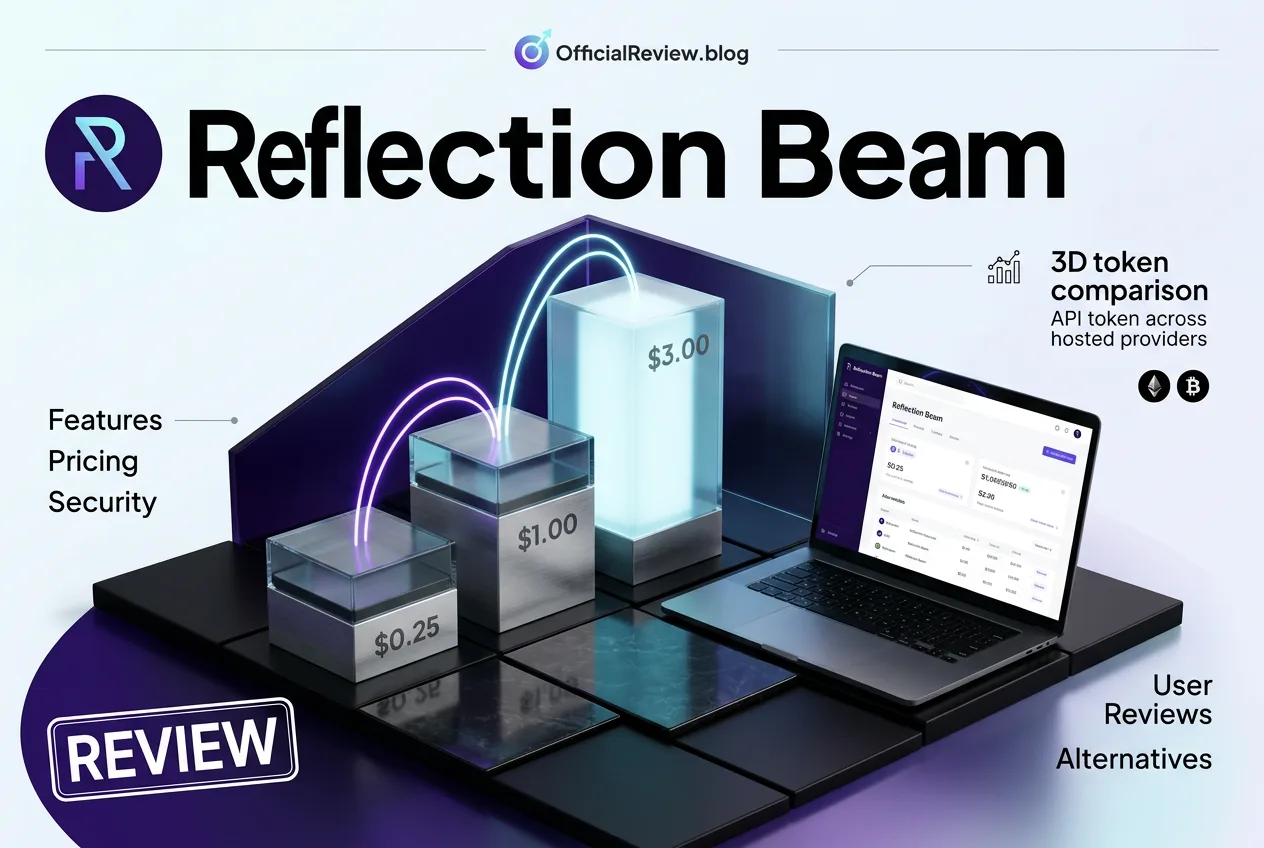
Reflection Beam trails GLM-5.2 slightly on several coding benchmarks yet shows competitive efficiency, requiring three to four times less inference compute on comparable reasoning tasks. It leads some agentic metrics against Meta Muse Spark Open but remains behind Kimi K3 and Qwen 3.8-Max on raw coding scores. The 1 million token context suits large codebases, though API providers currently enforce beta limits of 256K input and 128K output.
| Model | Active Params | SWE-bench Verified | Hosted Input Price |
|---|---|---|---|
| Reflection Beam | 23B | 80.9–81.6 | $0.25–$0.40/M |
| GLM-5.2 | ~30B | ~78 | $0.30–$0.50/M |
| Qwen 3.8-Max | ~40B | ~85 | $0.20–$0.35/M |
Limitations, User Feedback, and Verdict
Reflection Beam supports text only and lacks multimodal capabilities. Most benchmark numbers remain self-reported, with independent verification still emerging. Self-hosting hardware demands stay high, and early rate limits apply on hosted platforms. User discussions on technical forums note strong performance on long-context agentic tasks but highlight occasional over-refusal on edge-case prompts.
The Apache 2.0 license permits commercial use and fine-tuning, which differentiates it from more restrictive Western releases. Early adopters report reliable tool-calling behavior when reasoning effort is set to medium, the only available default. Further independent evaluations and self-distillation recipes are expected in coming months.
Frequently asked questions
What license does Reflection Beam use?
Reflection Beam weights are released under the Apache 2.0 license, allowing commercial use, fine-tuning, and self-hosting without restrictions beyond standard attribution.
How much does Reflection Beam cost on hosted platforms?
Pricing ranges from $0.25 to $0.40 per million input tokens on OpenRouter and Together AI, with output rates between $1.00 and $1.20 per million tokens depending on the provider and caching options.
What context length does Reflection Beam support?
The model architecture supports a 1 million token context window, although current API providers apply beta limits of 256K input and 128K output that may change.
Is Reflection Beam multimodal?
No, Reflection Beam processes text only and does not handle images, video, or other modalities.
Comments 10