Wasabi review: Pricing, Egress Limits, and Retention Rules for Hot Cloud Storage
Review summary
Wasabi Hot Cloud Storage uses flat-rate object storage at $7.99 per TB with no separate egress fees when usage stays within fair-use limits and 90-day retention rules.
Wasabi Hot Cloud Storage provides S3-compatible object storage under a single flat rate of $7.99 per TB per month. The service charges daily per-GB usage and applies a 1 TB monthly minimum even when actual stored data falls below that level. Launched as a lower-cost alternative to major cloud providers, it removes separate charges for ingress, egress, and API requests when account activity stays within stated policies.
Overview of Wasabi Hot Cloud Storage
Wasabi delivers hot object storage across regions in North America, EMEA, and APAC with uniform pricing. The platform supports standard S3 APIs along with IAM policies, object versioning, Object Lock for immutability, lifecycle management, and cross-region replication. Durability is rated at 11 nines with 99.9 percent availability. A 30-day trial exists but no permanent free tier is offered. Pricing rose from $6.99 to $7.99 per TB effective July 1, 2026 for both new and existing pay-as-you-go accounts.
Registration follows the typical cloud workflow: create an account, generate access keys, and begin uploading via any S3-compatible client or tool such as Veeam. The interface remains minimal because most users interact through APIs or third-party applications rather than a web console. Minimum billable object size is 4 KB. No native CDN or automatic tiering is included.
Security features center on Object Lock, which supports compliance and governance modes, and a Covert Copy function for additional ransomware protection. Data remains encrypted at rest. The company does not publish independent third-party audits in public materials, so verification of controls rests with individual account holders.
Wasabi Pricing, Egress Policy, and Retention Rules
Pay-as-you-go storage costs $7.99 per TB per month billed daily. Reserved Capacity Storage offers lower rates for 1-, 3-, or 5-year commitments starting at roughly 25 TB blocks, with premium support included and overages charged at standard rates. Contracts are non-cancellable and non-refundable. No separate fees apply for ingress, egress, or API calls provided monthly egress does not regularly exceed the volume of active stored data.
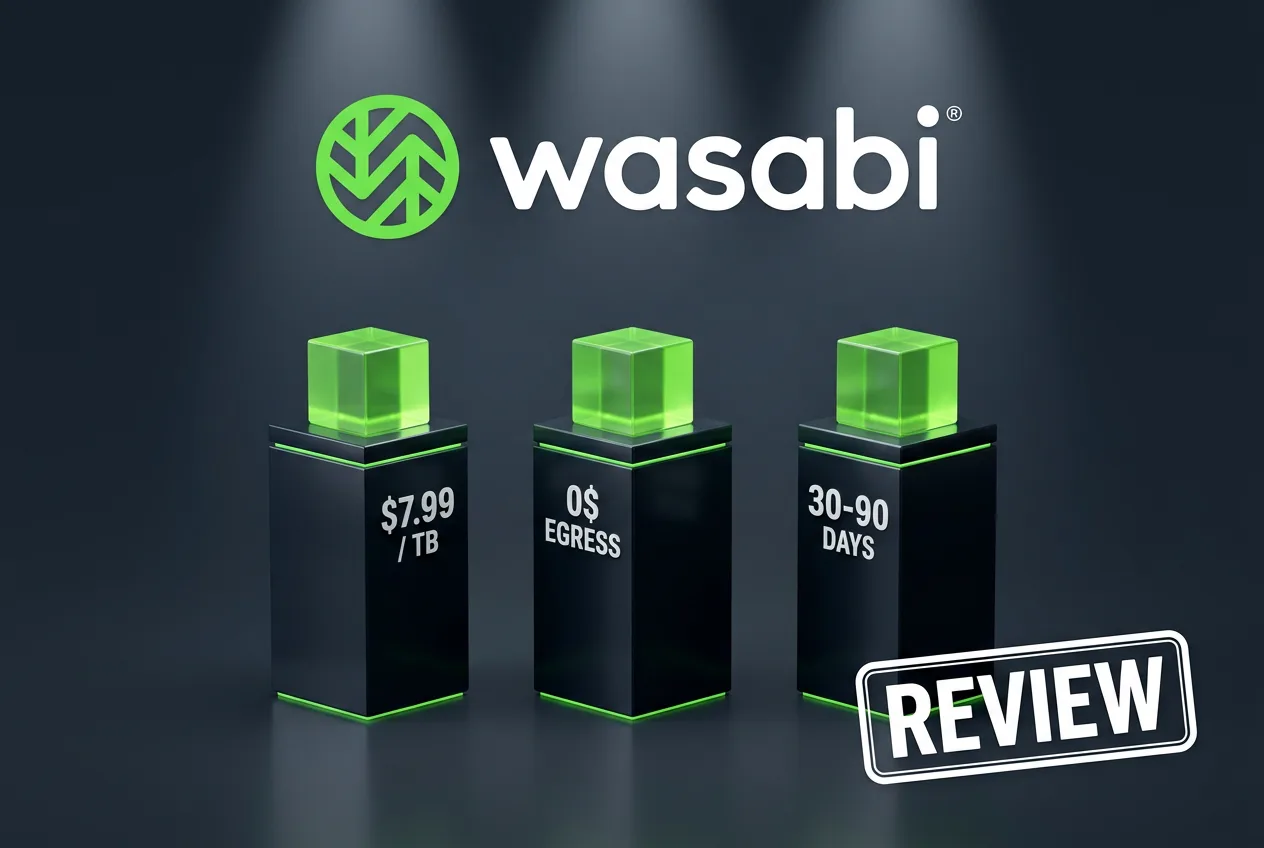
The fair-use egress policy states that egress up to the amount of stored data per month is acceptable. Accounts that exceed this pattern may face throttling or limits. A 90-day minimum retention applies to every object; early deletion triggers charges for the full 90 days. These rules create predictable costs only when workloads match the expected access patterns of backups and media archives.
Common advantages include the absence of surprise egress bills for compliant usage and straightforward monthly forecasting. Drawbacks appear for small datasets, short-lived objects, or frequent churn because the 1 TB minimum and 90-day retention produce charges regardless of actual consumption. No built-in CDN or intelligent tiering requires users to manage those functions externally.
Public user feedback on independent sites such as iTechGuides and DevOps Daily frequently mentions reliable performance with backup tools and clear billing when policies are followed. Complaints center on the retention penalty for test or ephemeral data and the practical limits of the egress allowance compared with truly unlimited options.
Wasabi Compared With Other Object Storage Providers
For a workload storing 1 TB with 500 GB monthly egress, Wasabi typically totals around $8. Other providers produce higher figures once egress and request fees are added. Backblaze B2 often reaches $11 under similar conditions, while Cloudflare R2 reaches approximately $15. AWS S3 costs rise further when egress traffic is included. Actual totals depend on whether the account stays within Wasabi’s egress and retention guidelines.
| Provider | Storage Cost (1 TB/mo) | Egress Included | Minimum Retention |
|---|---|---|---|
| Wasabi | $7.99 | Up to stored volume | 90 days |
| Backblaze B2 | $6 | First 3× stored volume free | None |
| Cloudflare R2 | $15 | Unlimited | None |
Limitations include the lack of native tiering and the requirement to monitor egress ratios manually. Organizations running high-churn workloads or needing sub-TB scale often find the minimums restrictive. Reserved Capacity terms add commitment risk because early termination is not permitted.
Wasabi suits steady backup, archive, and media workloads that can maintain egress below stored volume and keep objects for at least 90 days. Smaller or variable datasets require careful cost modeling before adoption because the flat-rate model only remains economical under those constraints.
Frequently asked questions
Does Wasabi charge for egress?
Wasabi allows free egress up to the volume of data stored each month under its fair-use policy. Regular exceedances can trigger throttling or account review rather than per-GB fees.
What is the minimum storage duration on Wasabi?
Every object carries a 90-day minimum retention period. Deleting objects earlier results in charges for the remaining days as if the full period had been used.
Is there a free tier for Wasabi Hot Cloud Storage?
Wasabi offers a 30-day trial but no ongoing free tier. All accounts are subject to the 1 TB monthly minimum billing once active.
How does Wasabi pricing compare with AWS S3 for backup workloads?
Wasabi charges a single $7.99 per TB rate with no separate egress fees when policy limits are observed. AWS S3 adds request and egress charges that frequently increase total cost for the same backup patterns.
Comments 1