PhotonPay Review: Stablecoin-Centric Financial OS After $40M Series C
Review summary
PhotonPay operates a Hong Kong-based stablecoin-centric Financial OS for global business payments, with $65B annualized volume and recent $40M Series C funding.
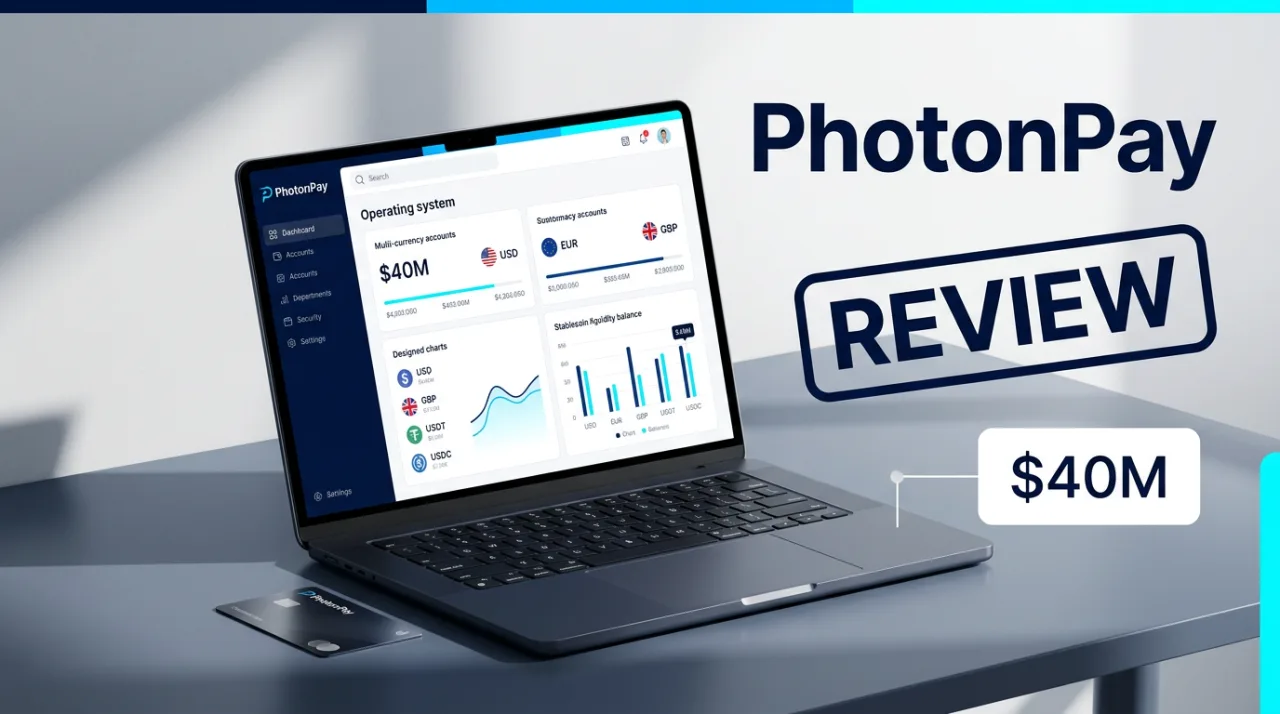
PhotonPay review examines a Hong Kong fintech founded in 2015 that runs a stablecoin-centric Financial OS for cross-border business payments. The platform combines multi-asset wallets holding USDC and USDT alongside fiat, local clearing, card issuing, billing, and checkout through one API. As of August 2026 it reported roughly $65 billion in annualized transaction volume across more than 200,000 business customers in over 200 countries and territories.
PhotonPay Features and Recent Funding Round
The company closed a $40 million Series C round at the end of October 2026 led by Blockchain Capital with participation from SBI Group, IDG Capital, GL Ventures, and Lightspeed Faction. Proceeds target expansion of multi-asset wallets, global card issuing, local compliance infrastructure, and an agent-ready execution layer aimed at AI-driven commerce. PhotonPay holds 34 payment and financial licenses across the Americas, Europe, and Asia, operates 16 offices with about 600 employees, and maintains partnerships that include Mastercard and Circle.
Key capabilities include local collection accounts in 17 markets, acceptance of funds in more than 60 currencies, and payouts through over 100 routes that cover 74 major local e-wallets. Approximately 97 percent of payouts settle same-day or within hours, while 68 percent occur in real time. The platform issues programmable virtual and physical cards on Mastercard and Discover networks, supports stablecoin-native subscriptions, and provides invoicing plus payment links. Dual-rail settlement allows 24/7 FX conversion between stablecoins and fiat without claimed hidden spreads.
Pricing, Security, Ease of Use, and User Feedback
Pricing follows a tiered, usage-based model that varies by service, volume, and corridor. A detailed fee schedule appears on the company site, though specific rates for virtual card transactions and other features are typically confirmed during onboarding rather than listed in a single public table. Free options or starter tiers are not prominently advertised.
Security measures include AML and KYT controls, Travel Rule compliance, segregated client assets, and SOC 2 certification. The platform emphasizes compliance infrastructure for both stablecoin and fiat flows. Registration occurs through an API-first dashboard that requires business verification; once approved, users access wallets, cards, and payout routes from a unified interface. No public data confirms average onboarding times.
Public third-party reviews remain limited. Trustpilot shows a 2.9 out of 5 rating from a small sample of roughly 11 reviews as of late 2026, with complaints centered on account freezes and processing delays alongside occasional praise for dashboard clarity and payout speed. Company responses appear on negative entries. Independent verification of reported volume and license counts is not widely available from third-party auditors.
Competitor Comparison, Limitations, and Final Assessment
Compared with Wise, which focuses on transparent fiat FX and local account details in dozens of currencies, PhotonPay adds stablecoin rails and card issuing. Versus Stripe, which offers broad developer tools and billing but limited native stablecoin support outside select partnerships, PhotonPay emphasizes dual-rail settlement and local e-wallet payouts in emerging markets. Payoneer provides similar cross-border collection accounts yet lacks the reported scale of stablecoin integration and recent AI-focused infrastructure plans.

| Aspect | PhotonPay | Wise | Stripe |
|---|---|---|---|
| Stablecoin support | USDC/USDT wallets | None | Limited |
| Local payout routes | 100+ | 80+ | Varies by region |
| Card issuing | Virtual/physical | None | Via partners |
| Reported volume | $65B annualized | Public filings | Not disclosed |
Limitations include sparse independent audits of metrics, a small public review sample, and pricing that requires direct inquiry for full details. Some users report delays during compliance checks. The platform continues to add jurisdictions and AI-agent features with no fixed timeline published.
PhotonPay review shows a platform with substantial reported scale, dual-rail payment options, and fresh capital for infrastructure growth, yet it also faces typical fintech constraints around transparency of fees and limited external validation of performance claims.
Frequently asked questions
What is PhotonPay?
PhotonPay is a Hong Kong-based company founded in 2015 that provides a stablecoin-centric Financial OS for global business payments, combining wallets, cards, billing, and cross-border settlement through a single platform.
How much funding has PhotonPay raised?
PhotonPay closed a $40 million Series C round in late October 2026 led by Blockchain Capital, with follow-on investment from SBI Group, IDG Capital, and others.
Does PhotonPay support stablecoins?
Yes, the platform offers multi-asset wallets that hold USDC and USDT alongside fiat, with 24/7 conversion and dual-rail settlement for payouts.
What do PhotonPay user reviews say?
Public reviews are limited. Trustpilot lists a 2.9 out of 5 score from a small number of reviews, with some complaints about account freezes and delays.
Is PhotonPay pricing public?
A fee schedule exists on the company website, but detailed rates depend on volume, corridor, and service and are often confirmed during onboarding.
Comments 3